What to Wear Under a Kimono Rental
Do you wear a bra with a kimono? Shops disagree, and we give both. Plus real size limits, the 3cm damage rule, and why what you arrive wearing matters most.
The short version: you supply only the innermost layer, and what you arrive wearing matters more than anything you pack.
A rental gives you three layers. Your own underwear goes on first. Then the shop’s hadagi or hadajuban, a thin under-slip. Then the nagajuban, a full-length under-kimono whose collar is the one you actually see at your throat. Then the kimono. One large Asakusa chain lists its plan as including the nagajuban, hadagi, obi, bag, tabi socks and zori, and says you can come empty-handed.
So the question people really mean is about the layer underneath all of that — and that layer is the one thing a rental set never contains. A Japanese kimono-rental guide puts it flatly: the kimono bra is the item rental sets do not include, and it is almost always something you bring yourself.
Do you wear a bra with a kimono?
Shops genuinely disagree, and we are going to report both rather than pick.
One large chain’s guidance is blunt: in everyday life a bra is essential, but when wearing kimono you should avoid one as far as possible. It gives three reasons, and they are mechanical rather than aesthetic: bust volume forces the collar overlap open and the whole garment starts to come apart; the desired shape is a straight cylinder; and the chest cord is tied at the underbust on both the nagajuban and the kimono, so two cords land exactly where an underwire sits and press it in.
Three Asakusa shops say the opposite. One states that ordinary everyday underwear is basically fine, and recommends a kimono bra or a non-wire bra only if you want the cleanest possible line. Another says explicitly that there is no rule requiring a kimono bra. A third says everyday underwear is fine, with two warnings worth more than the rule itself: avoid high necklines, and pale kimono are see-through enough that underwear shows — advice it extends to men, who should also pick skin-tone.
One correction on colour, because the instinct is wrong. Beige feels like the safe choice, and a beige lighter than your own skin shows through worse in sunlight than a dark one. Shops recommend deep cherry red, mocha or terracotta instead. It matters most under pale kimono, and under a yukata, whose back is a single layer.
The honest resolution: the shop that says remove it is giving formal-wear guidance, aimed at furisode for coming-of-age ceremonies rather than a tourist rental. No Asakusa rental shop requires anything — and it is worth being precise about why we can say that: no shop publishes an underwear policy on its plan pages or terms at all. All of this guidance lives in shop blogs. There is no rule to break here, only advice to take or leave. And every shop that offers advice points the same direction, so if you want one sentence to act on, it is this: non-wire, no padding, no lace or embroidery lines. Pull removable pads out — a shaped pad is working against the garment. A sports bra is a good choice, and better in summer heat.
One thing that is not a matter of taste: the kimono silhouette is deliberately a cylinder. One chain publishes its padding method as a table — flatten the bust, fill in the waist so it runs straight, same for hips and back, with the stated goal being a tube shape. A large bust gets suppressed with a kimono bra or sarashi wrapping; a very slim build gets the opposite treatment, with towels added at bust, waist and hip. Your dresser will use one or two face towels on you as a matter of course. Nobody is judging your body; they are building a shape the cloth was cut for.
What to arrive wearing — the tip that saves your photographs
A wide or deep neckline. The kimono collar is pulled back and down off the nape of the neck, and that is where a lot of the garment’s elegance lives. A crew-neck T-shirt sits above that line and appears in every single photograph you take that day.
Two more, from the shops themselves:
A front-opening top beats a pullover. You change after your hair is set. A jumper coming off over your head undoes the work.
Shallow-cut underwear, not high-waisted. One chain makes this point and it is the sort of thing only a dresser would think of: high-waisted shorts catch on the waist cord when you use the toilet, and that is the most common way a carefully dressed kimono comes loose.
In winter: a deep-V heat-tech layer, and ankle-length tights or leggings rather than anything that ends mid-calf where it will show.
Sizing: better than the internet thinks, but shop-specific
The figure that circulates is a 175cm ceiling for women. That is one shop’s limit, not the market’s, and repeating it turns a booking problem into an imaginary impossibility.
What Asakusa shops actually publish:
| Shop | Women | Men | Footwear |
|---|---|---|---|
| A shop publishing in English | to 185cm, bust/waist/hip each to 150cm | to 205cm | to 28cm women, 30.5cm men |
| A large Asakusa operator | to ~175cm, bust/hip to ~115cm | to ~195cm | to 27cm women, 29cm men |
| Another Asakusa chain | 3L stocked for 185cm and above, described as wearable over 190cm | — | — |
| A plus-size specialist | 3L to 10L, hips to ~130cm | S–5L | — |
So: men over 180cm are a non-issue — several shops go to 190–195cm and one to 205cm. Women above 175cm need to pick the right shop rather than give up, and two of them publish limits well above it.
Plus size carries no surcharge. Two shops say so explicitly; one notes only that stock is thinner, and there is a dedicated Asakusa plus-size specialist stocking to 10L. Check the individual listing’s restrictions all the same — two plans on the shelf this site sells from publish a 120 kg (264 lb) cap, and one of them is the cheap bare rental.
Two genuine constraints that are easy to miss:
Antique kimono run narrower than modern stock, so a vintage-look plan may not fit even when the shop’s standard range would.
Footwear is the tighter bottleneck than the garment — zori top out around 27cm at one shop and 28cm at another, with men’s setta reaching 29–30.5cm. If your feet are larger, see the footwear section; there is a straightforward way around it.
Several shops ask you to message your height, weight and shoe size when booking, and at least one asks you to write “large size requested” in the booking notes. That is not intrusiveness — it is them pulling stock before you fly, and it is worth answering accurately.
Tattoos, and the restriction that actually matters
Tattoos are not a constraint. We read four shops’ full terms of service, where the grounds for refusal are explicitly enumerated, and tattoos appear in none of them. One chain carries an affirmative anti-discrimination clause. This is not an onsen; nobody is looking.
Pregnancy is, and this is the one English-language guides miss entirely. Six of the thirteen plans this site lists flag pregnancy as unsuitable, the featured one included, and Asakusa shops word it in their terms as an absolute refusal. The kimono is held on by cords tied firmly at the waist and underbust, so the reason is obvious once stated — but if you are pregnant, you need to know before you book, not at the counter.
Footwear: where it actually hurts, and how to avoid it
The pain is not the sole. It is hanao-zure — the thong chafing between and over the toes, which is why it arrives suddenly after an hour rather than building. Rental zori are hard: a cork core with a thin sponge layer and essentially no cushioning.
A zori craftsman who has restrung more than 200,000 pairs names three causes, and two of them are technique rather than the sandal:
Do not push your foot all the way in. Leave about 5mm between your toe-cleft and the thong post. You grip the thong lightly between the big and second toe; jamming it home is what grinds the skin.
Your heel is supposed to overhang the back by 1–2cm. This is correct fit, not a sandal that is too small — and it is what stops you treading on your own hem, which causes both a collapsing kimono and falls.
Walk suri-ashi: small steps, slightly pigeon-toed, the whole foot landing flat and sliding. Never heel-first. Zori do not flex, so a normal heel-strike gait drives the entire load into the thong.
If it starts to rub, put a plaster or beige tape on the contact point before it hurts, and twist a little tissue into the toe gap. Do not loosen a rental’s thong yourself — a loosened thong cannot be reset by you, and shops say so directly.
Several shops also let you wear your own shoes. One Asakusa operator states plainly that it does not rent boots but you may use your own; another says the same. Boots under a kimono are a recognised Japanese look — it is standard styling for hakama — so this is a choice, not a compromise.
No shop publishes a realistic walking distance, which tells you something on its own. The structural answer is that Asakusa is sized for this: the core sights sit inside about a ten-minute walk — the temple two minutes from one shop’s door, Nakamise three, Sumida Park five — and shops themselves route tiring customers to a rickshaw. Treat Asakusa plus a café as comfortable, and a full day of city-scale walking as unrealistic unless you wear your own shoes.
If it rains
Shops do not cancel for weather, and you cannot cancel free on the day. One chain’s street-wear terms charge 50% the day before and 100% on the day. Another publishes an explicit clause refusing bad weather as a reason to cancel.
So the decision point is the night before, not the morning — and one Asakusa shop tells you outright how to play it: cancel free the day before, watch the forecast, then rebook as a same-day booking if it looks good. Free cancellation until 23:59 the previous day is standard at several shops, though one chain requires two days’ notice, so check yours.
It is not a disaster if you go anyway. Shops stay open and treat rain as normal: one lends stylish rain umbrellas free, another lends clear vinyl ones, a third lends rain zori as well as umbrellas and charges nothing for rain-wetting. The covered Nakamise arcade and the temple halls carry you through a shower. One warning if you upgraded to silk: rain stains are generally covered, but rain shrinkage is not.
A smaller trap in the same terms: one plan here cancels you with no refund after 10 minutes, and two others say 30.
Damage: the 3cm rule
This is the number to hold in your head. One widely used set of terms triggers a charge at multiple marks, or any single mark of 3cm or more — at which point it is roughly ¥7,000 for the kimono plus ¥500 for the obi.
Two things about that:
Ordinary eating is not a problem, but Nakamise has its own rule. No rental shop restricts eating, and a normal spill is covered — shops supply a kimono clip to pin your sleeves and hem clear. What voids the goodwill is oil, blood, tobacco burns, perfume sprayed onto the garment, and turning up drunk.
The rule that catches visitors is the street’s, not the shop’s: eating while walking is prohibited on Nakamise-dori, imposed jointly by Sensoji and the Nakamise merchants over hygiene and congestion, with signage along it. The Japanese distinction is worth carrying: tabe-aruki — stopping to eat your way between shops — is fine; aruki-gui, eating while in motion, is what is banned. Stand aside, or use the benches in the temple precinct. One rental chain warns its own customers about it, for the obvious reason that you are wearing their kimono.
One timing collision worth knowing: most Nakamise food stalls shut around 17:00, which is the same hour as your return deadline.
Silk is a different order of risk. One set of terms charges a flat ¥20,000 for a silk kimono plus ¥10,000 for the obi regardless of fault. If you are tempted by the silk upgrade, that is the real price of it.
Insurance is cheap and, for silk, obviously worth it — around ¥330 at one chain and ¥550 to ¥1,100 at another. For a polyester street rental it is a genuine toss-up. For silk it is not.
The one thing you cannot have
Worth knowing before you plan the day around a photograph: Sensoji’s grounds are open 24 hours and are genuinely quiet from about 07:00 to 09:00 — the main hall opens at 6:00, and the Nakamise shops do not open until 9:00 to 11:00, which is exactly why the empty-gate photographs exist.
No kimono shop is open then. The earliest dressing appointments start around 9:00 to 9:30, and with 45 to 70 minutes to dress you are outside at 10:00 at the very best — which is when the Nakamise becomes, in one Japanese description, too crowded to move through.
So you can have the empty temple, or you can have the kimono. Not both on the same morning. If the photograph matters more, go at dawn in your own clothes and book the kimono for the following day — and when you do wear it, walk the lanes west and north of the temple instead of the main approach.
Dates for the plan we feature
Dressing, hair styling and a matcha lesson two minutes from the Kaminarimon gate, with next-day return available if you want the temple after dark.
Shop policies on this page are as published by Asakusa and Tokyo rental operators in September 2026, and they differ between shops — the underwear guidance in particular is genuinely contested, which is why both positions are given. Terms change; confirm anything load-bearing with your own shop at booking.
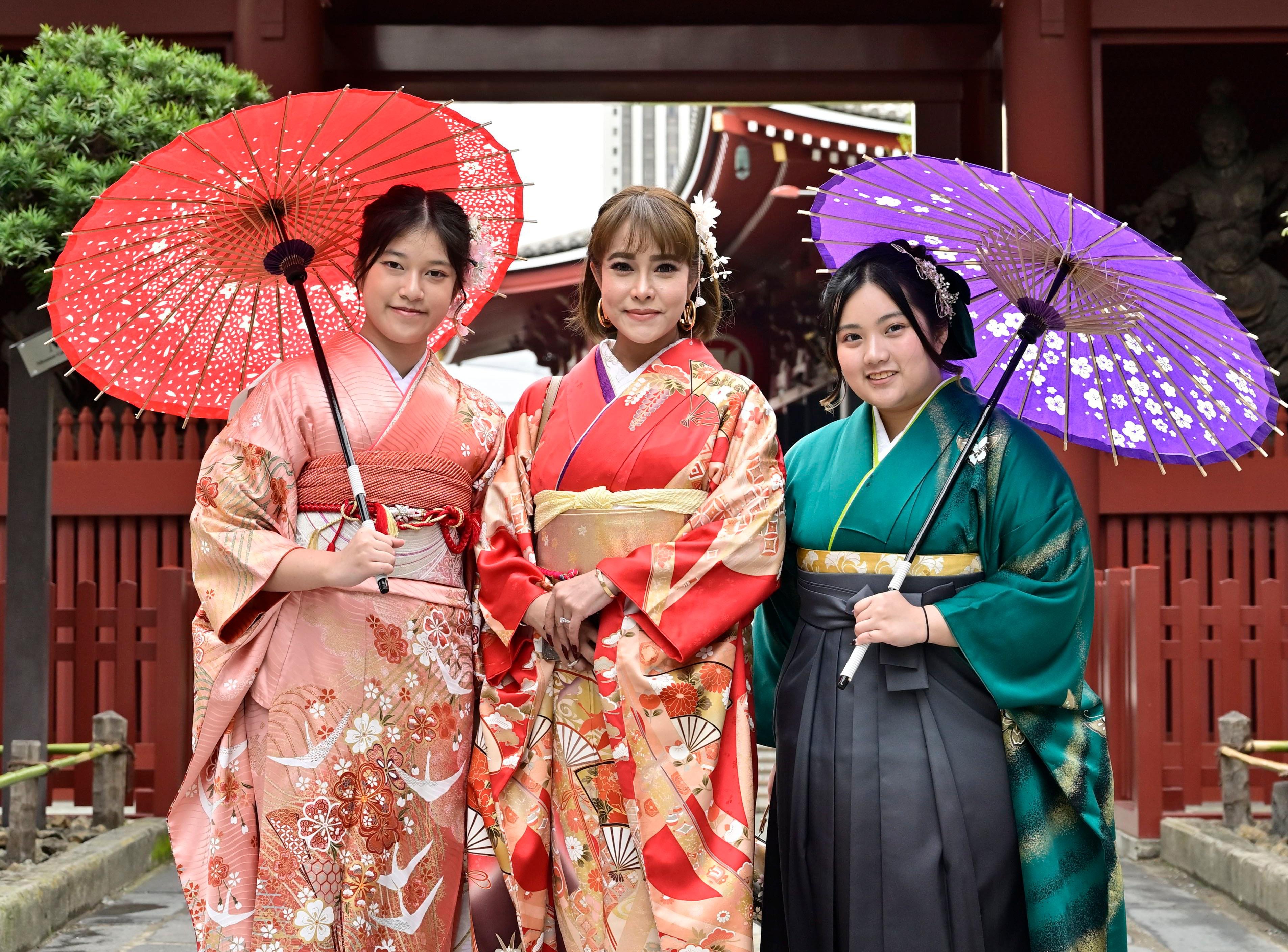
Dressing, Hair and Matcha, Two Minutes from Kaminarimon
Dressing, hair styling and a matcha lesson, two minutes from the Kaminarimon gate, with next-day return available at extra cost. Rated 4.9/5 by 269 verified guests, from about $57, with free cancellation.
Check Availability & Book