Can a Foreigner Wear a Kimono in Japan?
Japanese ministries, the tourism board and the weavers' associations actively encourage it. The famous controversies all happened outside Japan. Here is the evidence.
Yes. And rather than tell you that and move on, here is the evidence, including the parts that complicate it.
We have tried to keep two things separate throughout: what Japanese institutions and commentators say, and what non-Japanese commentators say about Japan. On this question those two groups have often said different things, and conflating them is how the confusion started.
What Japanese institutions actually do
Not statements — policy and money.
The Ministry of Economy, Trade and Industry (経済産業省) convened a formal kimono-promotion study group in 2015. Among its published proposals is disseminating kimono domestically and abroad to raise Japan’s appeal — industrial policy, not etiquette advice. METI has run a standing kimono-promotion council since November 2015 that was still meeting in 2025, with the chairs of the main kimono trade associations sitting on it.
The Japan National Tourism Organization markets kimono-wearing to inbound visitors across its multilingual guides, and frames it as responding to demand: its own guide opens by noting that demand from visitors for kimono-wearing is increasing, and offers tips on renting and wearing one.
The Agency for Cultural Affairs (文化庁) documents the state’s own kimono-dressing programmes for foreigners — sessions run by Japanese diplomatic missions abroad and by Japan House, and a kimono welcome at the 2019 TICAD7 leaders’ dinner.
Kyoto Prefecture, Kyoto City, the Nishijin weavers’ association and the Kyō-yūzen federation jointly run the Kyoto Kimono Passport: anyone wearing kimono gets discounted entry and perks at roughly 250 venues. Yukata, hakama and furisode all qualify. There is no nationality condition, and rented kimono is not excluded. An industry that objected to outsiders wearing its product would not run this.
The Nishijin weavers have shown free kimono displays seven times a day since 1956. During the inbound boom, foreign attendance rose so sharply that roughly 80% of the audience is now Chinese and Taiwanese visitors — reported by the Agency for Cultural Affairs as a fact about their own hall, without complaint attached.
And the detail we find hardest to argue with: the national kimono promotion body was founded in 1966 partly because of foreign visitors. It formed after people who came for the 1964 Tokyo Olympics asked why, if kimono was Japan’s national dress, they saw almost nobody wearing one.
One honest caveat. None of the above is an explicit declaration that “foreigners wearing kimono is not appropriation.” We looked for one and did not find it from any Japanese industry body. The welcome is revealed by what these organisations fund and promote, not by a quotable sentence. We would rather tell you that than invent the quote.
Where the controversies actually happened
All three of the incidents people remember occurred outside Japan.
Boston, 2015. The Museum of Fine Arts ran a kimono try-on beside a Monet painting. A protest group objected; the museum withdrew the try-on. Two things are usually left out: counter-protesters identifying as Japanese opposed the protest, and the same try-on had already run to a good reception at three Japanese museums.
Karlie Kloss in Vogue, 2017. Apologised for after criticism, largely from outside Japan. Japanese commentary ran closer to bafflement.
Kim Kardashian’s “KIMONO” shapewear, 2019. Renamed after a backlash. The objections differed in kind, and the difference is the interesting part: Japanese critics objected to underwear carrying the name of the national dress. Western critics framed it as appropriation. Those are not the same complaint.
One frequently-cited Japan Times essay on this topic is written by a Western academic based in Japan, not by a Japanese commentator. That does not make it wrong; it makes it mis-shelved when it is offered as the Japanese view.
Against that, a Japanese newspaper’s international edition reported the Boston episode roughly as: the Japanese people actually involved reacted with “why is this a problem?”, and the great majority feel pleased to see visitors photographed in yukata or kimono. The same writer drew a sharp line — blackface is taboo, kimono is not.
What the survey data says, and what it does not
Be careful here, because this evidence is thinner than people pretend.
There is no Japanese survey that directly asks whether foreign tourists should wear kimono. A large Agency for Cultural Affairs survey of 20,000 people is sometimes cited on this question. It is a properly built government survey, and it contains no such question. Anyone quoting it on this point is misusing it.
The only survey that touches the question is small — 400 respondents, run in March 2026 by an English-conversation-café brand as publicity research. Treat it as indicative, not authoritative. With that caveat, the pattern in it is consistent and worth reporting:
| What respondents were asked about | Found it uncomfortable |
|---|---|
| Foreign fans enjoying Japanese pop-culture cosplay, regardless of race or body type | 3.8% — the lowest of ten items |
| Sushi heavily altered to local tastes | 12.8% |
| Kanji tattoos chosen without knowing the meaning | 15.0% |
| Traditional dress modified into extremely revealing designs | 35.5% |
| Sacred motifs used as nightclub décor | 46.5% |
| Trademarking traditional Japanese names abroad | around 65–70% |
Discomfort tracks disrespect and commercial expropriation, not participation. Foreigners simply wearing the thing scores near the floor. Sexualising it and trademarking it score near the ceiling.
One more number from the same survey: 57% had never heard the term “cultural appropriation” at all.
The friction that is real, and is not about you
Two live Japanese arguments about kimono, neither of which concerns foreign visitors wearing one.
The kimono police. Self-appointed enforcers who publicly correct other Japanese people on collar direction, obi choice and seasonal rules. This is treated as a serious problem for the craft — METI’s own council looked at rigid rules as a barrier, and the framing in Japanese coverage is that the industry itself bears responsibility, and that people should be able to wear kimono without fear. If anyone is being policed here, it is Japanese beginners.
Behaviour in Gion. Kyoto has real, documented problems with visitors trespassing on private lanes and photographing people, particularly maiko, without permission. That is worth taking seriously. It is a problem about conduct, and it would not improve if the same visitors wore jeans.
So: what would actually be disrespectful
Since the evidence points at conduct rather than clothing, here is what it points at:
- Wearing it as a costume-shop parody — the survey’s worst-scoring dress item was traditional dress remade into something deliberately revealing.
- Photographing people, especially maiko and geiko, without asking, or following them.
- Going onto private property for a photograph.
- Wearing it into somewhere it does not belong. There is no prohibition on kimono at temples or shrines — it is welcome there.
None of that is about who you are. All of it is about what you do.
One rule, and the shop handles it for you
The collar wraps right panel first, left panel on top — for everyone, men and women. The reverse, left over right, is how the dead are dressed.
On a rental this is essentially impossible to get wrong, because a professional dresses you at every shop we checked. It matters if you dress yourself in a hotel or ryokan yukata.
The one trap that catches people is a photograph, not a garment: a phone’s selfie camera mirrors the image, so a correctly-worn kimono appears reversed in the picture. People then get “corrected” in their own comments by someone who has spotted a flip that is not there.
Book it, then
If you have read this far you are not looking for permission, you are looking for a shop. This is the Asakusa plan we feature — dressing, hair and a matcha lesson, two minutes from the Kaminarimon gate.
Sources for this page are Japanese government and industry publications — METI, the Japan National Tourism Organization, the Agency for Cultural Affairs, Kyoto Prefecture and the national kimono promotion body — plus Japanese press reporting, checked September 2026. Where a figure comes from a small commercial survey we have said so, and where we could not confirm something we have said that instead.
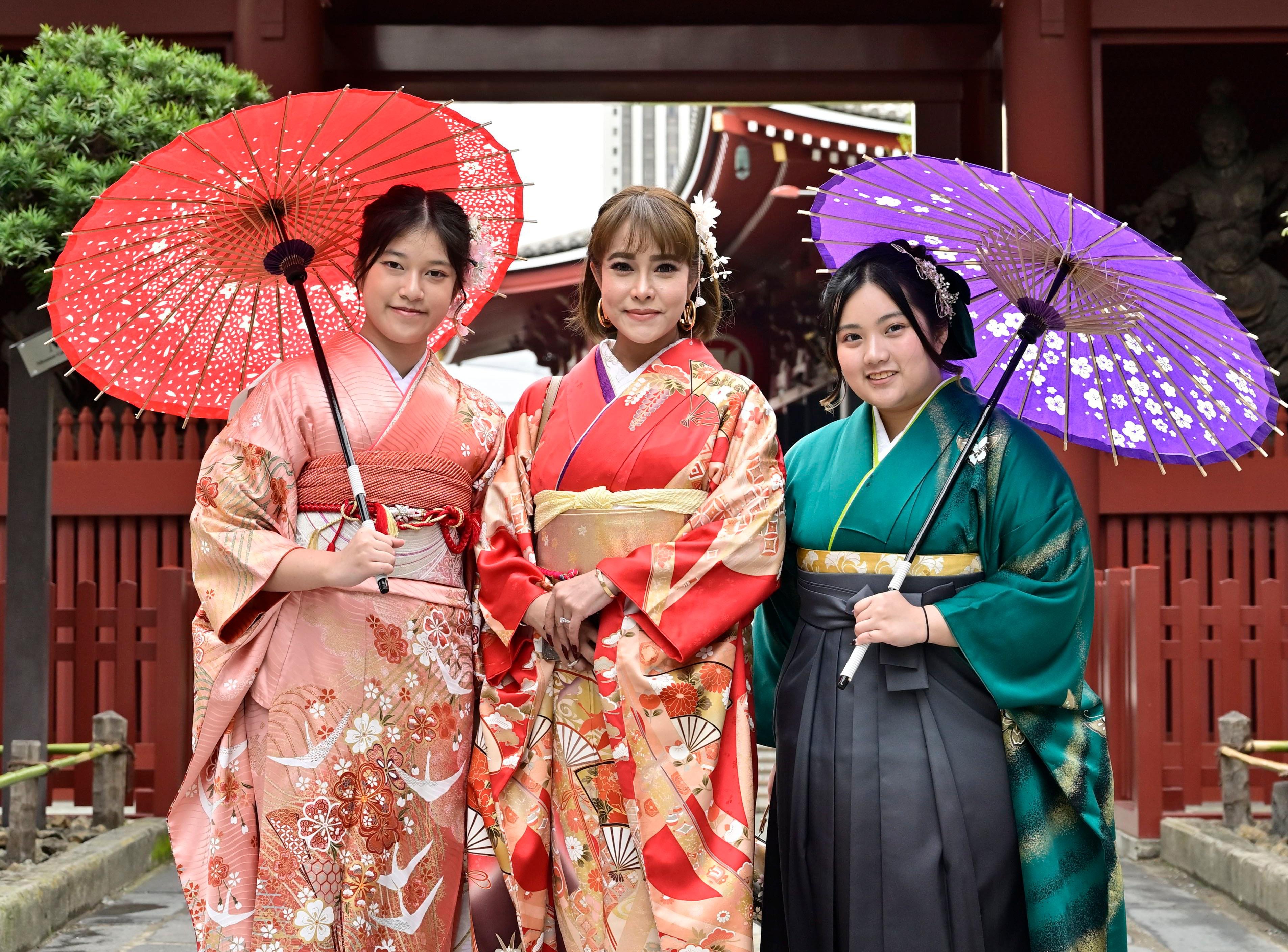
Dressing, Hair and Matcha, Two Minutes from Kaminarimon
Dressing, hair styling and a matcha lesson, two minutes from the Kaminarimon gate, with next-day return available at extra cost. Rated 4.9/5 by 269 verified guests, from about $57, with free cancellation.
Check Availability & Book